Overview
AccuNGS is a sequencing approach aimed at accurate deep sequencing of DNA or RNA, especially for clinical samples with low input that are difficult to sequence. It is composed of several stages that eliminate most errors that are created during library preparataion and sequencing.
When to use AccuNGS?
There are many sequencing techniques out there. What scenarios are suitable for AccuNGS sequencing? If your experiment meets the following criteria, AccuNGS sequencing may be good for you!
- If you want to identify alleles in a population that are as rare as 1:10,000.
- If you plan to sequence deeply (reach coverage of x1,000 and higher).
- If your population is not very heterogeneous of many diverged genomes. AccuNGS identifies variants that are relative to a central consensus sequence.
Warning
Since deep sequencing is usually obtained on short genomic regions, the software associated with AccuNGS was optimized to such scenario. For example, it works smoothly on full genomes of viruses. The software is not designed to run on long genomes, i.e. the entire human genome.
AccuNGS’s sequencing principles
The main idea behind this approach is to reduce the errors to a minimum. This is achieved by adhering to the following principles:
- High-yield reverse transcription reactions (RT) [if required]
- High-fidelity PCR reactions [if required]
- High-fidelity tagmentation
- Size selection for insert size that equals read size
- Illumina paired-end sequencing
- Sequencing of a homogeneous control sample for fitting specific distributions of errors
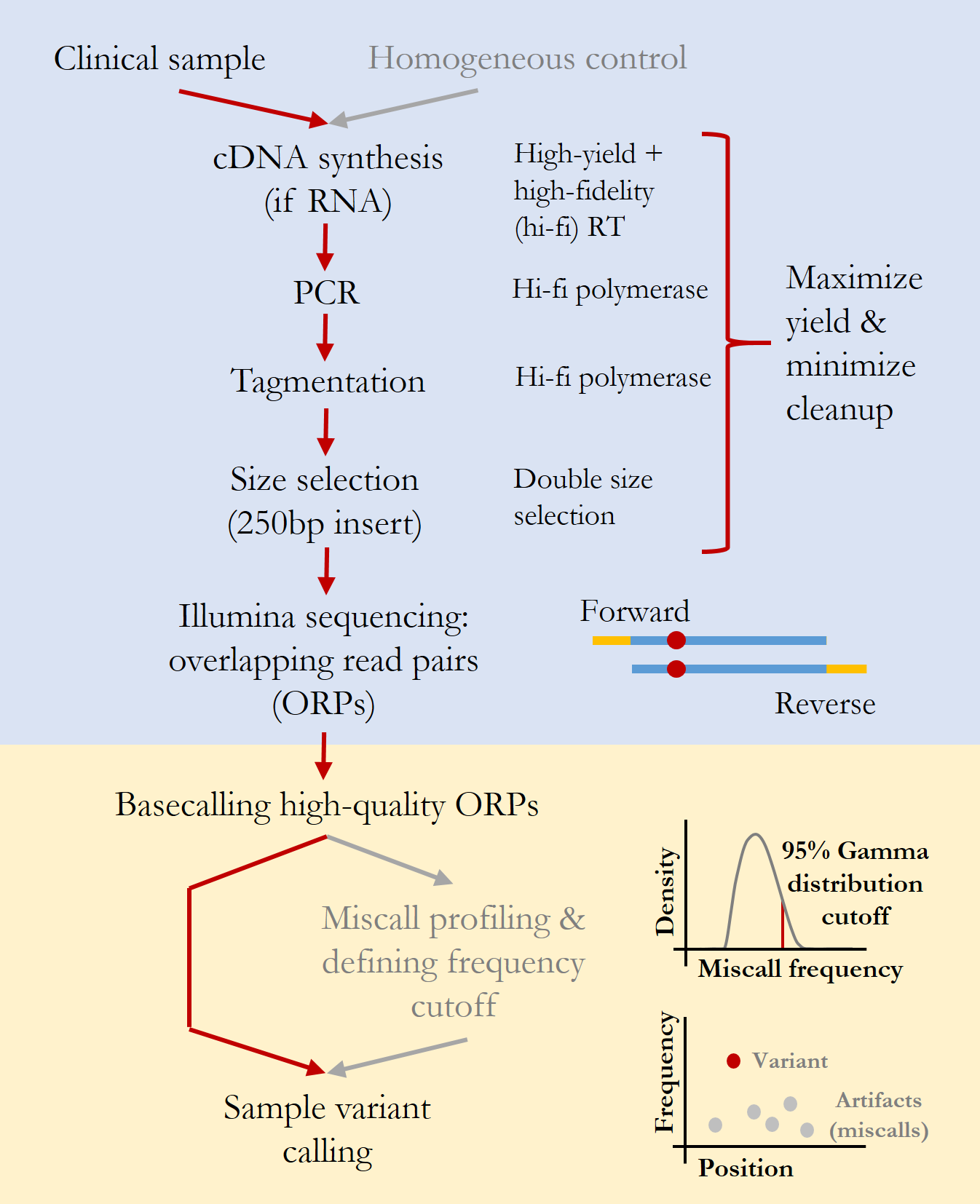
AccuNGS principles.
AccuNGS was calibrated as described in Citation.
AccuNGS - code
The code accompanying AccuNGS is divided into several stages, each carrying out a different stage in the computational analysis of sequencing output. The different stages are:
Note
AccuNGS code assumes its sequencing input quality scores to be compatible with the Sanger format encoded as ASCII +33 (standard Illumina FASTQ output since 2012).